


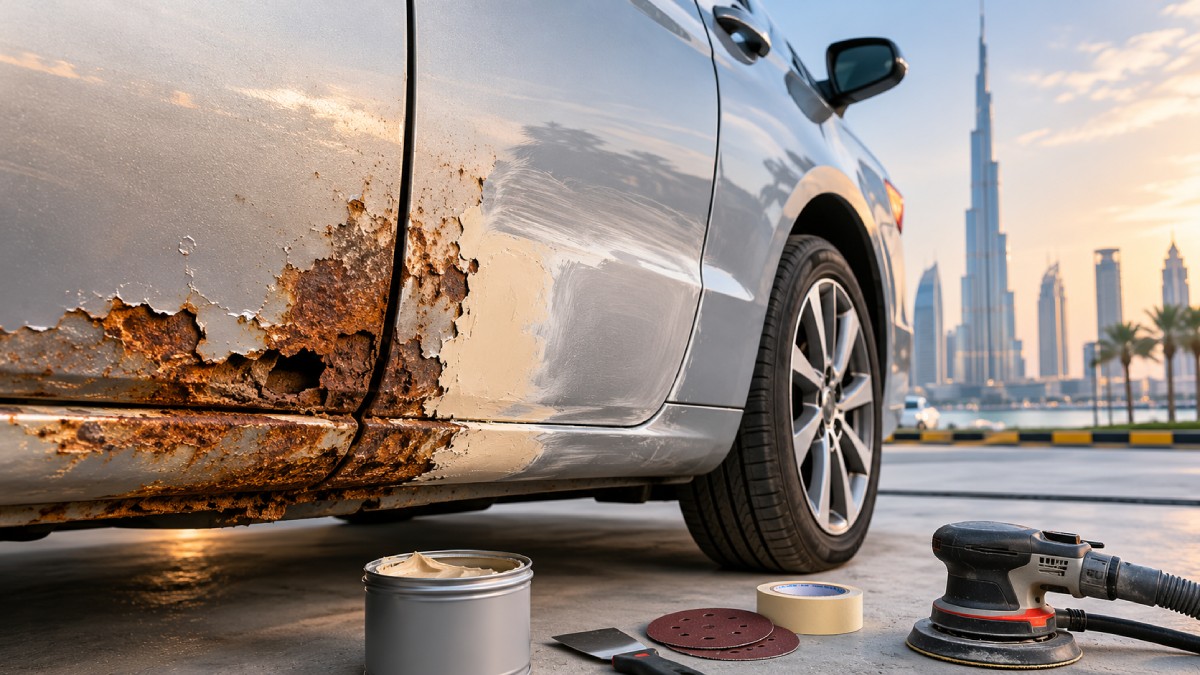
Rust rarely stays as small as it looks. A tiny bubble, orange edge, or paint chip can hide deeper corrosion under the paint, behind the panel, or around a structural seam. That is why How To Repair Rust On A Car? starts with diagnosis, not sanding.
The right repair depends on whether the rust is surface-level, pitted, perforated, or structural. This guide explains how to expose the real damage, decide when metal replacement is needed, use filler correctly, protect bare metal, and prevent the same rust from returning.
Quick Check: If the rust is spreading, bubbling, or close to a rocker, floor, wheel arch, or mounting point, schedule car rust repair in UAE before the damage turns into a larger bodywork problem.
How To Repair Rust On A Car?

Before choosing sandpaper, filler, converter, primer, or paint, identify the rust category. A cosmetic spot and a structural hole cannot be repaired the same way. How To Repair Rust On A Car becomes much clearer once the damaged area is classified correctly.
Rust Type Breakdown
|
Rust condition |
What it usually means |
Correct repair direction |
|
Surface rust |
Corrosion is mainly on the top layer; metal is still solid |
Remove rust to clean metal, protect, prime, paint |
|
Scale or deep rust |
Metal has pitting, flaking, or thinning |
Remove loose corrosion, assess strength, treat only if metal remains sound |
|
Perforation rust |
Rust has created holes or weak sections |
Cut out damaged metal, patch, weld, or replace panel |
|
Structural rust |
Rust affects rockers, floors, frame, suspension mounts, or load-bearing areas |
Inspect structure before cosmetic work |
A rust bubble should never be treated as only a paint defect. Strip the surrounding coating until you can see how far the corrosion travels. If you are checking a used vehicle, include rust in your used-car condition checklist before deciding whether the car is worth repairing.
Why Car Rust Looks Smaller Than It Is?
Rust often spreads under paint before it breaks through the surface. By the time a bubble appears, the corrosion may have already moved beyond the visible edge. This is common around wheel arches, rocker panels, quarter panels, door bottoms, and old repair areas.
The first step is to remove paint around the rust until the metal is exposed beyond the damaged zone. Do not stop when the panel looks cleaner. Stop only when you reach metal that is solid, bright, and not flaking or thinning.
This is also where repair economics matter. A small rust spot may be worth refinishing, but a badly rusted removable panel may be more practical to replace. For older cars, compare the repair scope against repair labor and parts variables before committing to cosmetic work.
Inspect Behind The Rust Before Sanding
Many rust repairs fail because only the outside face is repaired. Rust can start inside a panel and move outward, especially where moisture collects behind liners, seams, or enclosed cavities. Wheel arches and rocker areas are the most common examples.
Where access is possible, check behind the wheel-arch liner, inside the door bottom, under the sill area, and around any seam where debris or moisture can collect. If corrosion is coming from behind the panel, refinishing the outside alone will not stop the rust from returning.
For owners dealing with arch bubbling or panel corrosion in the city, rust repair in Dubai should include both the visible panel and any accessible backside source of moisture or corrosion.
Remove Rust Until Sound Metal Remains
For surface rust, the repair goal is simple: remove corrosion until clean, solid metal remains. Use mechanical removal such as sanding, abrasive pads, or grinding only as appropriate for the panel thickness and repair area. The surface must be cleaned, degreased, and protected quickly after preparation.
Do not leave bare steel exposed. Once rust is removed, the metal needs a compatible corrosion-control system, primer, basecoat, and clearcoat. Primer alone is not the final weather barrier.
If you are preparing for inspection or renewal, do not hide rust with paint. Use bodywork to correct the actual defect, then follow proper vehicle inspection requirements and renewal test preparation steps so the vehicle is checked honestly.
When Rust Converter Helps And When It Does Not

Rust converter is useful only when it is part of a correct repair system. It is not a magic coating that restores missing steel. Loose scale still needs to be removed, the remaining metal still needs to be inspected, and the product instructions still need to match the primer and paint system.
Converter may be suitable for minor corrosion in areas where sound metal remains. It should not be used to disguise holes, weak rockers, rotten floors, or rust around structural points. If the metal has become thin or perforated, replacement metal is the repair, not more chemical treatment.
The safest rule is this: converter can treat remaining surface oxidation; it cannot rebuild strength.
Use Body Filler Only After Metal Repair
Body filler is for shaping. It is not a substitute for rusted-away metal. When used correctly, filler smooths small imperfections over a properly prepared and sound repair area. When used incorrectly, it traps a cosmetic shape over active corrosion, and the rust returns through the paint.
Never pack filler into a rust hole and treat it as a permanent repair. If the hole is on a non-structural cosmetic panel, a temporary repair may hide the damage for a while, but it should not be presented as equal to welded steel or panel replacement.
For deeper rust, panel dents, and corrosion in older body sections, denting and rust painting in Sharjah should focus on correcting the metal condition before cosmetic shaping starts.
When Car Rust Needs Welding Or Panel Replacement?
Welding becomes relevant when metal is perforated, badly thinned, cracked around seams, or cannot be cleaned back to sound steel. A proper perforation repair usually means cutting past weak metal, fitting replacement metal, welding or bonding according to the repair method, sealing the repair, then refinishing.
Panel replacement may be more sensible when the affected part is removable, the rust is widespread, or the labor needed to rebuild the section exceeds the value of the panel. Fenders, doors, and some bolt-on parts can sometimes be replaced more cleanly than reconstructed.
Repair Method Comparison
|
Rust situation |
Avoid this shortcut |
Better repair decision |
|
Small surface spot |
Painting over orange metal |
Sand to clean metal, prime, refinish |
|
Rust bubble |
Sanding only the raised paint |
Strip wider area and inspect hidden corrosion |
|
Pitted metal |
Filling over loose scale |
Remove scale and confirm the metal is still strong |
|
Rust hole |
Mesh and filler as a permanent fix |
Cut out rotten metal and patch or replace |
|
Rocker or floor rust |
Cosmetic filler to pass inspection |
Structural inspection before repair |
|
Rust after previous paintwork |
Repainting the new bubble only |
Investigate remaining corrosion behind or beside repair |
For vehicles needing broader correction, the complete repair workflow is useful because rust repair often overlaps with denting, paint preparation, panel alignment, and safety checks.
Structural Rust Needs A Different Decision
Rust near rockers, floors, frame sections, jack points, suspension mounts, and load-bearing unibody areas is not just an appearance issue. These parts help support the vehicle, absorb load, or locate critical mechanical components. Cosmetic filler does not restore that strength.
If corrosion appears near suspension mounting points, inspect related components as well. Rust damage and impact damage can both affect alignment, ride height, and control-arm behavior, so check suspension damage signs when the rust is near the underside.
Braking parts should also be checked if the vehicle has heavy corrosion underneath. Rust around wheels, hubs, and underbody sections can appear alongside brake problem patterns, especially when a car has been neglected for a long time.
Why Rust Comes Back After Repair?
Rust usually returns because the repair did not remove or isolate the real source. Common causes include corrosion left in pits, rust behind the panel, moisture trapped in a seam, exposed bare metal, incompatible primer, poor sealing, or filler applied over active rust.
A smooth finish does not prove the repair is complete. The panel may look perfect while corrosion continues underneath. This is why backside inspection, seam sealing, cavity protection, and compatible paint systems matter.
After repair, reinspect the area periodically. Watch the edge of the repair, backside seams, door bottoms, arch lips, and any spot where the paint film was previously broken.
Paint, Primer, And Weather Conditions Matter
A rust repair can fail even after the corrosion is removed if finishing is rushed. Bare metal needs proper cleaning, compatible primer, basecoat, and clearcoat. Each product also has its own application temperature, humidity range, curing time, and sanding window.
Do not copy one universal drying time from a DIY example. Follow the technical instructions for the actual converter, filler, primer, paint, and clear being used. If the weather or workspace prevents correct curing, delay the refinishing stage rather than trapping moisture or solvent under paint.
Paint match is another practical issue. Even factory paint-code touch-up can look slightly different if the original paint has aged, faded, or weathered. Blending and clearcoat technique often determine whether the repaired rust patch disappears or remains visible.
How To Repair Rust On A Car? Area Coverage

Local repair planning matters because rust repair depends on how the vehicle is used, where it is parked, and how quickly exposed metal is protected after damage. The same rust bubble may need a minor refinish, metal patching, or structural inspection depending on the panel and vehicle condition.
UAE Car Repair Services
Across the UAE, rust repair should begin with classifying the corrosion before sanding or painting starts. A practical repair path checks whether the rust is surface-level, pitted, perforated, or structural. This helps drivers avoid spending money on a cosmetic finish when the panel actually needs metal repair, replacement, or underside inspection.
Abu Dhabi Car Repair Services
For Abu Dhabi drivers, visible rust on arches, doors, fenders, and lower body sections should be inspected beyond the painted surface. Rust painting in Abu Dhabi should not mean covering orange metal with primer; it should mean removing corrosion, protecting clean metal, and refinishing the repair area with a compatible system.
Dubai Car Repair Services
Dubai rust repairs often need careful assessment because many vehicles are bought, sold, inspected, and renewed on a regular schedule. A rust bubble near a visible panel may be cosmetic, but rust near floors, rockers, or mounting points needs more caution. The repair should support the vehicle’s condition, not simply hide a defect before testing or resale.
Sharjah Car Repair Services
Sharjah drivers dealing with dents and rust together should repair the metal condition first. If a dent has cracked paint and exposed bare steel, corrosion can spread under the coating. The proper sequence is damage assessment, rust removal, metal correction, surface shaping where appropriate, primer, paint, and clearcoat.
Ajman Car Repair Services
For Ajman vehicles, small rust spots should be checked early before the damaged area grows. Car rust service in Ajman is most useful when it separates minor surface corrosion from deeper panel damage and helps drivers decide whether sanding, refinishing, welding, or replacement is the safer choice.
Final Rust Repair Decision
The safest answer to How To Repair Rust On A Car? is to repair the cause, not just the stain. Surface rust can often be removed, protected, primed, and refinished. Deep rust, holes, and structural corrosion need stronger decisions, including metal replacement or professional inspection.
If the rust is spreading, returning after repair, or sitting near a structural area, book car rust repair in UAE so the panel can be assessed before cosmetic work hides the real problem. A proper rust repair should leave clean metal protected, weak metal replaced, and hidden corrosion checked wherever access allows.
FAQs About How To Repair Rust On A Car?
How do I know if car rust is surface rust or deep rust?
Surface rust usually appears as light orange corrosion on metal that is still solid. Deep rust shows pitting, flaking, scale, thinning, bubbling paint, or soft metal. The only reliable way to know is to remove surrounding paint and loose corrosion until the true condition is visible. If clean, strong metal remains, surface repair may work. If the metal flakes, bends, or has holes, the repair needs a deeper metalwork decision.
How bad is rust when the paint starts bubbling?
Paint bubbling can be more serious than it looks because corrosion may already be spreading under the coating. A bubble often means moisture or corrosion is active beneath the paint film. The repair should not begin with filler or paint. Strip the area wider than the bubble, inspect for pitting or holes, and check the backside where possible. If the rust extends far beyond the visible bubble, the panel may need patching or replacement.
Can surface rust be repaired without welding?
Yes, surface rust can often be repaired without welding when the metal is still strong. The damaged area should be cleaned, sanded back to sound metal, treated if the product system requires it, primed, painted, and sealed. Welding is not needed for every orange spot. It becomes relevant when corrosion has eaten through the metal, weakened the panel, or affected a structural section.
Can a rust hole be repaired without welding?
A rust hole on a non-structural cosmetic panel can sometimes be covered with a temporary patch system, but that should not be treated as equal to replacing metal. If the surrounding metal is thin or the hole is near a rocker, floor, frame, or mounting point, a non-welded cosmetic patch is not a structural repair. A proper long-term fix usually means cutting out rotten metal and installing sound replacement material.
Can body filler be used over car rust?
Body filler should not be used over active rust. It is meant for surface shaping after the metal has been repaired and prepared correctly. If filler is applied over rust, the corrosion can continue underneath and eventually blister through the new paint. The correct order is rust removal, metal assessment, metal repair where needed, surface preparation, filler only where appropriate, primer, paint, and clearcoat.
Why did rust come back after I repaired it?
Rust usually comes back because some corrosion remained under the repair, behind the panel, inside a seam, or beside the sanded area. It can also return when bare metal was not protected quickly, primer and paint were incompatible, or moisture was trapped under filler or coating. Reappearing rust means the repair should be reopened and inspected rather than simply sanded and repainted again.
When does car rust become unsafe?
Car rust becomes a safety concern when it affects structural areas such as rockers, floors, chassis sections, frame rails, suspension mounts, seatbelt mounting areas, or jack points. These sections are not just cosmetic. They help support the vehicle and locate important components. If rust is near these areas, the vehicle should be inspected before spending money on paintwork.
Is it better to repair or replace a rusted car panel?
It depends on the panel, rust depth, vehicle value, and labor required. A small surface spot may be worth repairing. A removable fender with widespread corrosion may be cheaper and cleaner to replace. A structural section cannot be judged by appearance alone. The decision should compare the amount of metal loss, repair access, paint blending, safety risk, and whether rust is also present on the backside.
How can I prevent rust from returning after repair?
Preventing rust from returning means removing corrosion fully, protecting bare metal quickly, using compatible primer and paint, sealing seams properly, and checking the backside of the panel where accessible. Wheel arches, rockers, door bottoms, and enclosed cavities need extra attention because moisture can attack from behind. After repair, inspect the area periodically for new bubbles, edge lifting, or paint cracks.

